
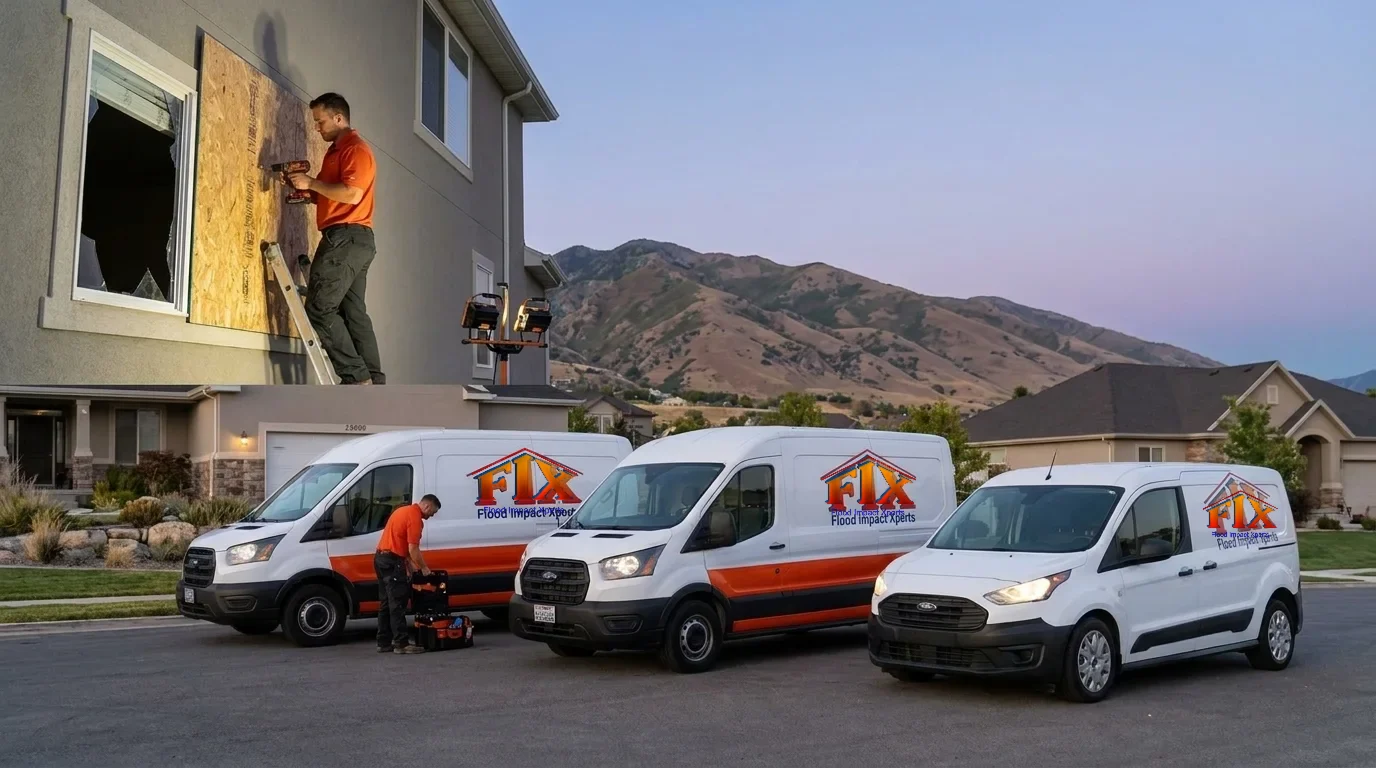
Emergency Board-Up and Tarping in American Fork
Emergency board-up and tarping in American Fork and surrounding areas. Insurance billing accepted. Call (801) 930-9750.
Need an emergency board-up in American Fork? Call now for emergency service. Our crew responds fast to secure broken windows, doors and roofs.
A broken window, a caved-in roof section, or a fire-damaged wall doesn’t just look bad, it’s an open invitation for rain, wind, vandalism, and secondary damage that your insurance adjuster will scrutinize closely. The window of time between the initial loss and a proper board-up or tarp installation is often measured in hours, not days. Every hour that gap stays open, the scope of the claim can grow: water intrudes, soot migrates, and salvageable materials cross the line into replacement territory.
What Emergency Board-Up and Tarping actually involves
Board-up and tarping is protective work, not cosmetic work. The goal is to create a weather-tight and secure barrier over any structural opening, broken windows, knocked-out doors, collapsed roof decking, fire-compromised wall sections, until permanent repairs can begin.
For window and door board-ups, crews cut plywood to fit each opening, fasten it with structural screws into the surrounding framing (not just the sill or casing), and seal edges to limit air and water infiltration. For larger openings or compromised walls, heavier sheathing and additional fastening patterns are used.
Roof tarping involves more than throwing a blue poly sheet over a hole. A proper tarp installation uses reinforced poly tarps rated for the expected weather load, anchored with wood nailers screwed into solid decking on all four sides, not just weighted down at the edges. The tarp needs to extend well past the damaged area on every side so wind-driven rain can’t work underneath it. In Utah, where afternoon thunderstorms can arrive fast in summer and early snowfall can load a compromised roof in fall, a poorly anchored tarp can fail overnight and double the interior damage.
Timeline: a straightforward board-up on a single window or door typically takes under an hour on-site. A multi-opening fire board-up or a large roof tarp can run two to four hours depending on roof pitch, access, and the number of openings.
Our process
-
Site assessment and hazard identification. Before any material goes up, the crew walks the structure to identify all openings, check for structural instability, and note any active hazards, downed utilities, weakened flooring, smoldering materials after a fire. Boarding a building that isn’t safe to enter requires a different approach than a straightforward broken window.
-
Measurement and material staging. Each opening is measured precisely. Plywood is cut on-site to fit. Tarp dimensions are calculated to ensure adequate overlap beyond the damaged area, typically a minimum of several feet on each side of the breach, more on roof installations where water can travel laterally under wind pressure.
-
Installation and anchoring. Boards are fastened into structural members, not just finish materials. Roof tarps are secured with nailer boards screwed into solid decking, with edges sealed where the tarp meets intact roofing. Every fastener point is checked before the crew leaves.
-
Photo documentation for insurance. Every opening is photographed before and after installation. The documentation captures the cause of the opening, the materials used, fastener placement, and the condition of surrounding materials. This record is what your insurance adjuster needs to approve the emergency services line item on your claim.
-
Handoff and next-step coordination. The crew communicates what they found, additional damage not visible from the exterior, moisture already present inside, structural concerns, so that the restoration scope can be built accurately before permanent repairs begin.
What separates a good board-up response from a bad one
The most common failure in emergency board-up work is inadequate fastening. Plywood screwed only into window trim or door casing, rather than into the jack studs and header behind it, will pull free in wind. A tarp held down with sandbags or cinder blocks instead of anchored nailer boards is a temporary fix that may not survive a Utah canyon-wind event or a heavy snowfall.
A second common problem is incomplete coverage. After a fire, crews sometimes board only the most obvious openings and miss soffit vents, attic access points, or sections of wall where fire weakened the sheathing without creating a visible hole. Insurance adjusters look for evidence that all entry points were addressed, gaps in coverage can create disputes over which subsequent damage was preventable.
Documentation quality matters more than most homeowners realize. Adjusters need to see the condition of the opening before the board went up, the materials used, and the fastening method. Crews that skip pre-installation photos leave the homeowner without evidence to support the emergency services charge.
Finally, material selection matters for fire-damaged structures specifically. After a fire, smoke and soot residue on framing members can off-gas and contaminate interior air even through a boarded opening. Experienced crews account for this when selecting barrier materials and sealing methods for fire board-up jobs.
What does Emergency Board-Up and Tarping cost?
Typical costs for emergency board-up and tarping vary based on the number of openings, roof access difficulty, material requirements, and whether the loss involves fire, storm, or impact damage. Most homeowners pay somewhere in the ranges below, these are industry-typical figures, not FIX Restoration quotes, and every loss is different; FIX Restoration provides a written scope before work begins so there are no surprises.
| Scenario | Typical industry range |
|---|---|
| Single window or door board-up | $150 – $400 |
| Multiple openings (3–6 windows/doors) | $400 – $900 |
| Fire damage board-up, single-story | $800 – $2,500 |
| Fire damage board-up, two-story or large structure | $2,000 – $5,000+ |
| Roof tarp, small breach (under 200 sq ft) | $300 – $700 |
| Roof tarp, large or steep-pitch roof | $700 – $2,000+ |
Homeowners insurance typically covers emergency board-up and tarping as a mitigation expense when the underlying loss, fire, storm, vandalism, or sudden structural failure, is a covered peril. Documenting the work thoroughly is what gets that line item approved.
Seasonal and regional considerations
In Utah County, the timing of a structural breach matters. Summer monsoon moisture arrives quickly and without much warning along the Wasatch Front, meaning a roof opened by a hail strike in the afternoon can take on significant water before evening. Fall brings early snow at higher elevations, and even valley-level properties can see wet, heavy snow on a compromised roof before a contractor can schedule permanent repairs.
Homes in American Fork and surrounding communities span a wide range of construction eras and roof types, from older ranch-style homes with low-slope roofs to newer construction with steeper pitches. Tarp anchoring methods and material choices should reflect the specific roof geometry, not a one-size approach.
Winter board-ups also need to account for temperature differentials. A boarded opening that isn’t adequately sealed can allow cold air infiltration that affects drying equipment performance if water damage is also present, something to flag during the handoff to the restoration crew.
Service area
FIX Restoration is based in American Fork and serves communities throughout Utah County and the surrounding area, including Lehi, Pleasant Grove, Lindon, Orem, Provo, Highland, Cedar Hills, and Eagle Mountain. The city-specific pages for each of those areas link back here for the full service description.
If your property has an open structural breach right now, call (801) 930-9750 to secure it before the next weather event makes the damage worse.
Services We Handle
- Emergency Tarping
Frequently Asked Questions
Does homeowners insurance cover emergency board-up and tarping?
How is a roof tarp properly anchored, and why does the method matter?
What's the difference between boarding up after a fire versus after storm or impact damage?
What should I do to protect my property while waiting for the board-up crew to arrive?
How do I know if all the openings in my structure have been identified and covered?
Looking for the best emergency board-up and tarping company in American Fork?
FIX Restoration provides emergency board-up and tarping in American Fork, UT and the surrounding area, and has served local property owners since 2012. Customers rate us 4.9 out of 5 stars across 558 Google reviews. We answer calls 24/7 — call (801) 930-9750 for immediate help.
Need Emergency Board-Up and Tarping now?
We respond 24/7 across American Fork and surrounding UT cities.
Related Coverage
- Our Restoration Services
- Contact FIX Restoration
- Emergency Board-Up and Tarping in Highland
- Emergency Board-Up and Tarping in Lehi
- Emergency Board-Up and Tarping in Orem
- Emergency Board-Up and Tarping in Pleasant Grove
- Emergency Board-Up and Tarping in Provo
- Emergency Board-Up and Tarping in Saratoga Springs
- Emergency Board-Up and Tarping in Spanish Fork
- Emergency Board-Up and Tarping in Springville
- Emergency Board-Up and Tarping in South Jordan
- Emergency Board-Up and Tarping in Draper
- Emergency Board-Up and Tarping in Herriman
- Emergency Board-Up and Tarping in Riverton