Emergency Fire Damage Restoration in American Fork
Emergency fire damage restoration in American Fork and surrounding areas. Insurance billing accepted. Call (801) 930-9750.
Fire damage emergency in American Fork? Call now for emergency service. Our crew responds fast to secure the property and start the recovery.
The fire is out, but the damage is still spreading. Soot particles continue to etch into porous surfaces for days after the flames are extinguished. Acidic smoke residue corrodes metal fixtures, discolors grout, and permanently stains synthetic fabrics if it isn’t neutralized quickly. The smell that seems to fade in a few hours will resurface weeks later from inside wall cavities, HVAC ducts, and subfloor framing, long after a surface cleaning has been done. Fire damage restoration is a race against secondary damage that most homeowners don’t know is still happening.
What fire damage restoration actually involves
Fire losses create at least three overlapping problems: structural damage from heat and flames, smoke and soot contamination across the entire structure (not just the burn area), and water damage from firefighting efforts. A thorough restoration addresses all three, and the order of operations matters.
Soot is not uniform. Protein soot, from burning food, grease, or organic material, is nearly invisible on surfaces but produces an intense odor and leaves a sticky, hard-to-remove film. Synthetic soot from burning plastics, insulation, or composite materials is heavy, oily, and deeply penetrating. Each type requires different cleaning chemistry. Misidentifying the soot type is one of the most common reasons a “cleaned” home still smells like smoke six months later.
Smoke travels through a structure by following air pressure differentials, it moves into wall cavities, attic spaces, and ductwork far beyond the room of origin. In Utah County’s older housing stock, where balloon-frame construction is common in pre-1950s homes, smoke can travel vertically through wall cavities from the basement to the attic with almost no obstruction. Restoration crews need to account for the full migration path, not just the visible burn zone.
Water from suppression, whether from a sprinkler system or fire hoses, soaks structural assemblies that are already weakened by heat. That water needs to be extracted and dried using the same equipment and protocols as a standalone water loss, or mold colonization can begin within 24 to 48 hours.
Our process
-
Emergency stabilization and board-up. Before restoration begins, the structure needs to be secured against weather and unauthorized entry. Tarping damaged rooflines and boarding compromised windows prevents additional moisture intrusion and protects salvageable contents.
-
Soot characterization and scope development. A technician identifies the soot types present, maps the full extent of smoke migration using both visual inspection and odor tracing, and documents every affected surface and system. This documentation also forms the foundation of the insurance claim.
-
Contents pack-out and inventory. Salvageable personal property is catalogued, packed, and transported to a controlled facility for cleaning and deodorization. Leaving contents in a smoke-saturated structure during the restoration process re-contaminates items that have already been cleaned.
-
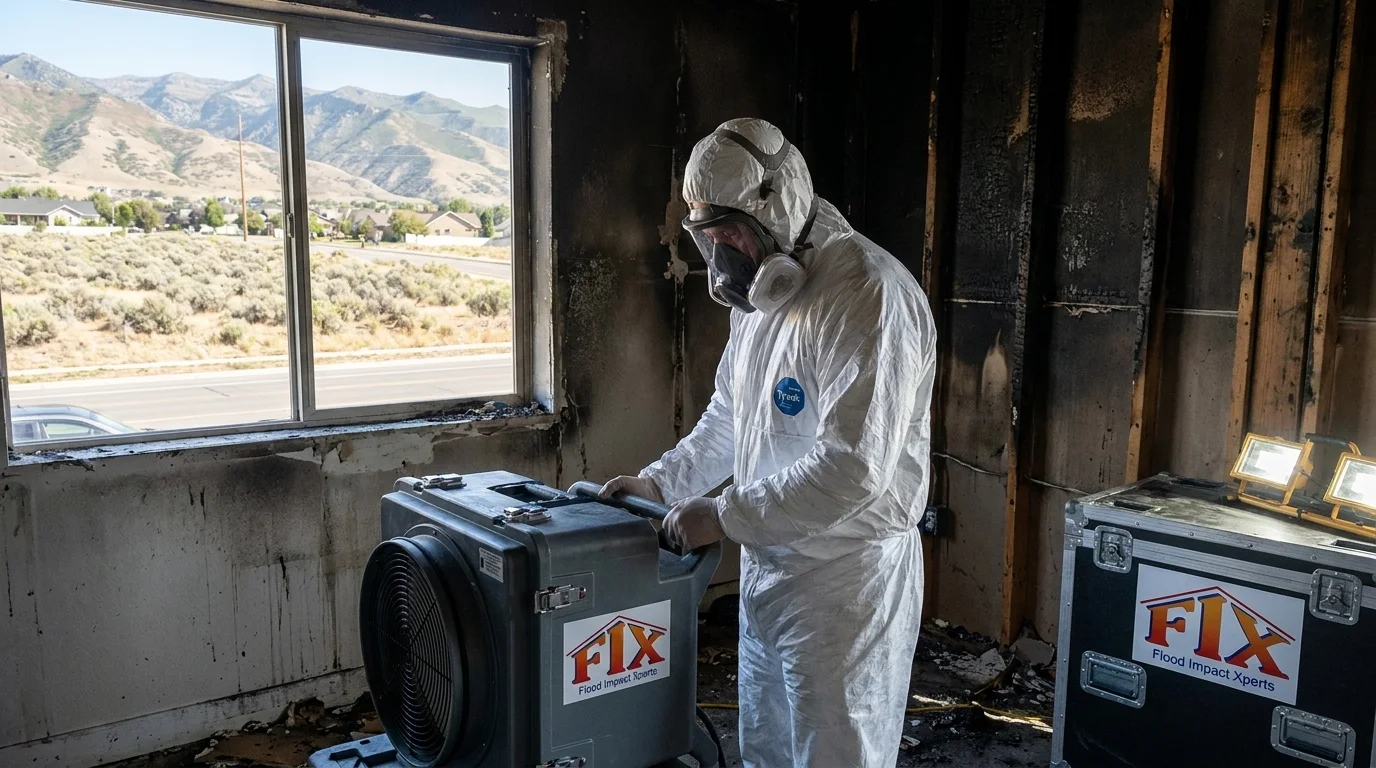
Structural cleaning, HEPA vacuuming, and chemical treatment. Dry soot is removed first using HEPA-filtered vacuums before any wet cleaning begins, wet-wiping dry soot smears it deeper into porous surfaces. Affected materials are then cleaned with appropriate chemistry matched to the soot type. Thermal fogging or ozone treatment is used to neutralize odor molecules embedded in structural materials, not just to mask surface smells.
-
Structural drying and reconstruction. Fire-suppression water is extracted and dried using commercial dehumidifiers and air movers. Once materials reach target moisture levels, reconstruction begins, framing, drywall, insulation, finishes, returning the structure to pre-loss condition.
What separates a good fire damage response from a bad one
The most common failure in fire restoration is treating it as a cleaning job rather than a contamination problem. Wiping visible soot off walls without addressing smoke migration inside cavities leaves behind odor sources that no amount of air freshener will fix. A homeowner may not notice for weeks, until the HVAC system cycles and distributes smoke residue through every room.
Insurance adjusters look for a documented scope that accounts for smoke migration beyond the burn room, a contents inventory with condition notes, and moisture readings that confirm fire-suppression water was fully dried. A scope that only addresses visible fire damage is a scope that will generate a supplement claim, or worse, a dispute, later in the process.
Odor neutralization is another area where shortcuts show up quickly. Ozone treatment and thermal fogging are effective when the structure is properly prepared and the equipment is run for the correct duration. Running either treatment too briefly, or skipping it in favor of paint-over-odor approaches, produces results that fail the first warm day of the year when the structure heats up and residual odor volatilizes out of the framing.
What does fire damage restoration cost?
Typical costs for fire damage restoration vary significantly based on the size of the loss, the soot types involved, whether contents pack-out is needed, and the extent of reconstruction required. Most homeowners pay somewhere in the ranges below, these are industry-typical figures, not quotes from FIX Restoration.
| Scenario | Typical industry range |
|---|---|
| Single room, limited soot, no structural damage | $3,000 – $8,000 |
| Single room with structural damage and water from suppression | $8,000 – $20,000 |
| Multi-room smoke migration, partial reconstruction | $20,000 – $50,000 |
| Kitchen fire with full contents pack-out | $15,000 – $35,000 |
| Whole-home loss with major structural damage | $80,000 – $200,000+ |
Every fire loss is different, and FIX Restoration provides a written scope of work before any work begins. Homeowners insurance typically covers fire damage restoration, including smoke cleanup, contents, and reconstruction, subject to your policy’s deductible and coverage limits. FIX Restoration works directly with your carrier and handles the claim documentation.
Seasonal and regional considerations
In Utah County, dry winters and low relative humidity mean smoke odor compounds can become more concentrated and harder to detect until warmer months arrive, when rising temperatures volatilize residues that seemed inert during the cold season. Homes that burn during heating season often have fire-suppression water freeze inside wall cavities before it can be extracted, which complicates both the drying scope and the insurance documentation. Summer wildfires in the Wasatch Front foothills also produce a distinct type of smoke infiltration, exterior smoke intrusion through HVAC systems and gaps in the building envelope, that requires a different remediation approach than a structure fire.
Service area
FIX Restoration is based in American Fork and serves property owners throughout Utah County, including Lehi, Pleasant Grove, Orem, Provo, Lindon, Cedar Hills, Highland, and surrounding communities. Each city service page links back here for the full technical detail on what fire and smoke restoration involves.
If your home or building has fire or smoke damage, call FIX Restoration at (801) 930-9750 to begin smoke and soot removal before secondary damage compounds the loss.
Frequently Asked Questions
What's the difference between protein soot and synthetic soot, and why does it change how the cleanup is done?
How far does smoke actually travel beyond the room where the fire started?
Does homeowners insurance cover fire damage restoration?
Why does smoke odor sometimes come back weeks after a fire was cleaned?
What should I do, and not do, in the hours immediately after a fire while waiting for restoration to begin?
Looking for the best fire damage restoration company in American Fork?
FIX Restoration provides fire damage restoration in American Fork, UT and the surrounding area, and has served local property owners since 2012. Customers rate us 4.9 out of 5 stars across 558 Google reviews. We answer calls 24/7 — call (801) 930-9750 for immediate help.
Need Fire Damage Restoration now?
We respond 24/7 across American Fork and surrounding UT cities.
Related Coverage
- Our Restoration Services
- Emergency Smoke Damage Restoration in American Fork
- Odor Removal and Deodorization in American Fork
- Reconstruction Services in American Fork
- Contact FIX Restoration
- Emergency Fire Damage Restoration in Highland
- Emergency Fire Damage Restoration in Lehi
- Emergency Fire Damage Restoration in Orem
- Emergency Fire Damage Restoration in Pleasant Grove
- Emergency Fire Damage Restoration in Provo
- Emergency Fire Damage Restoration in Saratoga Springs
- Emergency Fire Damage Restoration in Spanish Fork
- Emergency Fire Damage Restoration in Springville
- How To Choose a Restoration Company in American Fork (Without Getting Burned)
- The Fire Damage Restoration Process, Explained
- The 5 Best Fire Damage Restoration Companies in American Fork, UT (2026)
- Fire Damage Restoration Cost in American Fork, UT: What a Real Job Runs (2026)