
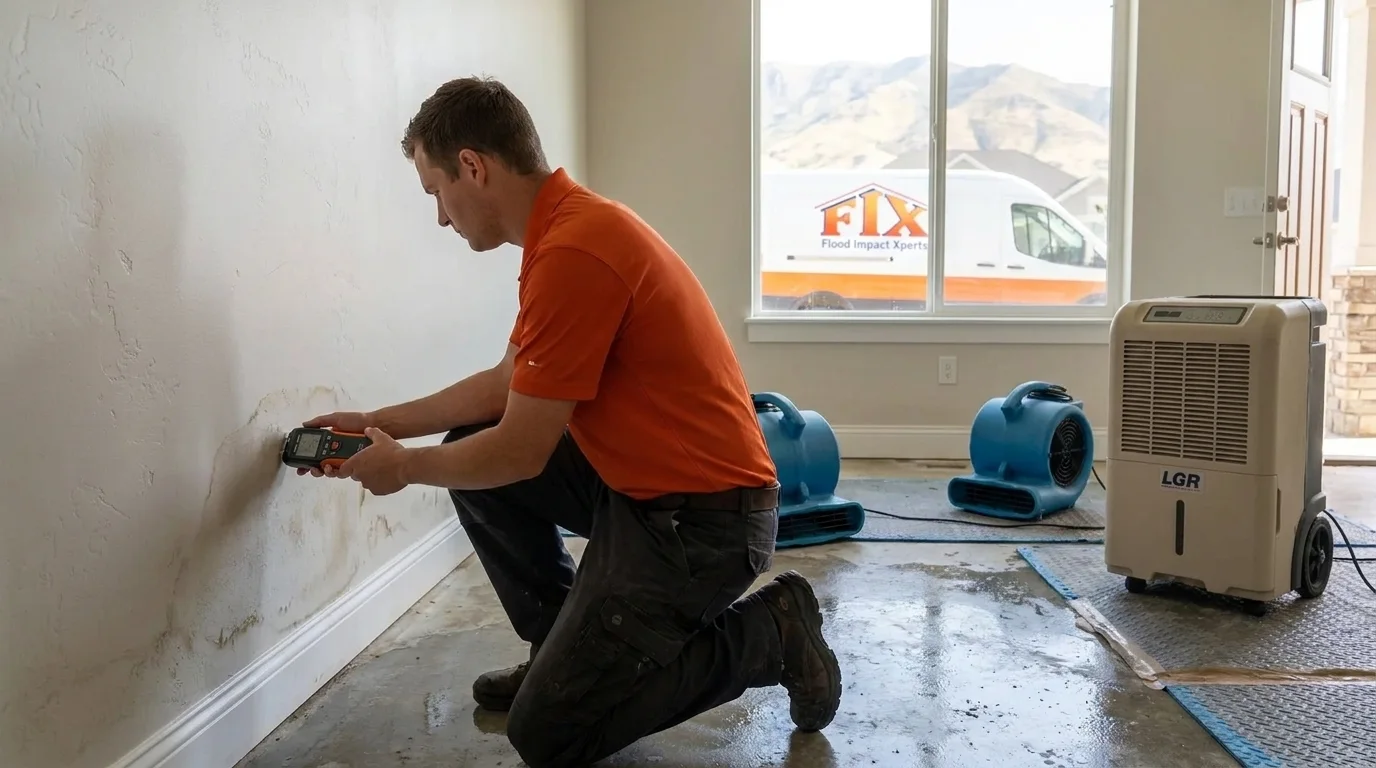
Emergency Water Damage Restoration in American Fork
Emergency water damage restoration in American Fork and surrounding areas. Insurance billing accepted. Call (801) 930-9750.
Water damage emergency in American Fork? Call now for emergency service. Our crew responds fast to stop the water and start drying your property.
Water you can see is rarely the whole problem. A burst pipe or washing machine overflow soaks carpet and drywall fast, but the water that wicks into wall cavities, migrates under subfloor sheathing, and saturates insulation behind a vapor barrier is what drives mold growth, structural softening, and the kind of secondary damage that shows up weeks later on an insurance reinspection. Water damage restoration is the work of finding all of it, not just the visible puddle, and removing it completely before the clock runs out.
What Water Damage Restoration actually involves
The work is part emergency response, part forensic investigation. Technicians use thermal imaging cameras and calibrated moisture meters to map how far water has traveled through building materials, because water follows framing, insulation, and gravity in ways that don’t match the stain on the ceiling. Once the scope is mapped, truck-mounted or portable extractors pull standing water and saturate moisture from carpet, pad, and hard flooring. Then the drying phase begins: industrial air movers and refrigerant or desiccant dehumidifiers run continuously, often for several days, to drive moisture out of structural materials and into the air where dehumidifiers can capture it.
The category of water matters enormously. Clean water from a supply line (Category 1) is handled differently than gray water from a dishwasher or washing machine (Category 2), and both are handled very differently from sewage or floodwater (Category 3). Category 2 and 3 losses require containment barriers, antimicrobial application, and in many cases the removal of porous materials, drywall, insulation, carpet, that cannot be dried to a safe moisture level without creating a mold hazard.
Timeline: most residential structural drying jobs reach target moisture levels in three to five days. Concrete slabs, dense hardwood, and thick plaster can extend that window. Every day of monitoring produces a drying log that documents the progress, that log is also what your insurance adjuster will want to see.
Our process
-
Inspection and moisture mapping. Before any equipment is placed, technicians walk the full affected area with moisture meters and thermal imaging to document the actual spread of water, not just the obvious wet zones. This step determines the drying plan, the equipment load, and the scope of any necessary material removal.
-
Water extraction. Standing water is removed first using truck-mounted extractors or high-capacity portables. Carpet and pad are extracted in place when salvageable; saturated pad is almost always removed because it holds water that air movers cannot reach efficiently.
-
Structural drying and containment. Air movers are positioned to create a vortex effect across wet surfaces; dehumidifiers capture the evaporated moisture before it can migrate to unaffected areas. For Category 2 or 3 losses, plastic containment barriers isolate the work zone to prevent cross-contamination.
-
Daily moisture monitoring. Readings are logged at the same measurement points each visit. Drying is not complete when materials feel dry to the touch, it is complete when moisture meter readings reach the IICRC S500 standard for the material type and the regional equilibrium moisture content. In Utah’s dry climate, target readings are typically lower than in humid regions, which can actually accelerate drying when equipment is sized correctly.
-
Final documentation and clearance. A complete drying log, photo documentation of affected materials, and a written scope of completed work are provided at closeout. This package is what supports a clean insurance claim and protects you if questions arise later.
What separates a good water damage response from a bad one
The most common failure is stopping too soon. Surface readings can show dry while the material behind a wall or under a floor remains saturated. Technicians who rely on touch rather than calibrated meters, or who pull equipment before drying logs confirm target moisture levels, leave behind the conditions that produce mold colonies within 24 to 72 hours of a loss.
A second common problem is under-scoping Category 2 and 3 losses. Gray water contains bacteria and surfactants that penetrate porous materials quickly. Drying contaminated drywall in place rather than removing it is a shortcut that creates a health hazard and a liability, and insurance adjusters who review the file later will flag it.
What good operators do differently: they document everything before, during, and after. Adjusters and carriers increasingly require drying logs that show daily psychrometric readings, temperature, relative humidity, and specific humidity, not just a final photo. A restoration company that cannot produce that documentation leaves you exposed if the claim is disputed.
What does Water Damage Restoration cost?
Typical costs vary significantly based on the size of the affected area, the category of water, and how much structural material requires removal. Most homeowners pay somewhere in the ranges below, these are industry-typical figures, not quotes from FIX Restoration.
| Scenario | Typical range |
|---|---|
| Single room, clean water (Cat 1), no material removal | $1,200 – $3,500 |
| Single room, gray water (Cat 2), partial drywall removal | $2,500 – $6,000 |
| Multi-room or whole-floor clean water loss | $4,000 – $10,000 |
| Finished basement, clean water | $5,000 – $15,000 |
| Category 3 (sewage/floodwater), any size | $7,000 – $30,000+ |
| Crawl space water intrusion | $2,000 – $8,000 |
Every loss is different, and FIX Restoration provides a written scope before work begins so there are no surprises. Homeowners insurance typically covers sudden and accidental water damage, a burst pipe, appliance failure, or roof leak from a storm, but generally excludes gradual leaks and flood events, which require separate flood coverage.
Seasonal and regional considerations
American Fork sits at the foot of the Wasatch Range, and the local water damage calendar reflects it. Spring snowmelt and rapid temperature swings in March through May push groundwater levels and send runoff toward foundations, particularly in older neighborhoods built before modern drainage standards. Freeze-thaw cycles through the winter months stress supply lines in uninsulated exterior walls and garage spaces; pipe bursts often happen overnight when temperatures drop sharply and go undiscovered until morning.
Summer monsoon moisture, while less dramatic than in other parts of Utah County, can still drive roof leaks and window intrusion in homes with aging flashing or flat-roof additions. The region’s low ambient humidity is an asset during drying, when equipment is sized correctly, structural drying often moves faster here than in coastal climates, but it also means that improperly dried materials can appear to recover at the surface while staying wet inside.
Service area
FIX Restoration is based in American Fork and serves communities throughout Utah County and the surrounding area, including Lehi, Pleasant Grove, Lindon, Orem, Provo, Cedar Hills, Highland, and Eagle Mountain. The city-specific pages linked from this site go deeper on local housing stock, drainage patterns, and common loss types for each area.
If you’re seeing water where it doesn’t belong, or you’re not sure whether you have a problem, call (801) 930-9750 to schedule a moisture assessment. Bring in the meters before the damage has time to spread.
Services We Handle
- Water Mitigation
- Wet Carpet Drying
Frequently Asked Questions
Does homeowners insurance cover water damage restoration?
How long does structural drying take, and what affects the timeline?
What is the difference between Category 1, 2, and 3 water damage, and why does it matter for cleanup?
What should I do, and not do, while waiting for the restoration crew to arrive?
Can water-damaged hardwood floors be saved, or do they always need to be replaced?
Looking for the best water damage restoration company in American Fork?
FIX Restoration provides water damage restoration in American Fork, UT and the surrounding area, and has served local property owners since 2012. Customers rate us 4.9 out of 5 stars across 558 Google reviews. We answer calls 24/7 — call (801) 930-9750 for immediate help.
Need Water Damage Restoration now?
We respond 24/7 across American Fork and surrounding UT cities.
Related Coverage
- Our Restoration Services
- Mold Remediation in American Fork
- Emergency Water Removal & Cleanup in American Fork
- Emergency Flood Damage Restoration in American Fork
- Contact FIX Restoration
- Emergency Water Damage Restoration in Highland
- Emergency Water Damage Restoration in Lehi
- Emergency Water Damage Restoration in Orem
- Emergency Water Damage Restoration in Pleasant Grove
- Emergency Water Damage Restoration in Provo
- Emergency Water Damage Restoration in Saratoga Springs
- Emergency Water Damage Restoration in Spanish Fork
- Emergency Water Damage Restoration in Springville
- Burst Pipe Checklist: Step-by-Step Response
- What To Do in the First 24 Hours After Water Damage
- How To Choose a Restoration Company in American Fork (Without Getting Burned)
- The 5 Best Water Damage Restoration Companies in American Fork, UT (2026)
- Water Damage Repair Cost in American Fork: What Drives the Price
- Who to Call for Water Damage Restoration in American Fork, UT