
Emergency Water Removal & Cleanup in American Fork
emergency water removal and cleanup in American Fork and surrounding areas. Insurance billing accepted. Call (801) 930-9750.
Water moves fast and hides well. Within the first hour after a pipe bursts or an appliance line fails, water migrates under baseboards, wicks up drywall, and saturates subfloor assemblies that look completely dry from above. By 24 to 48 hours, that hidden moisture creates the conditions mold needs to colonize. Emergency water removal isn’t just about getting the water out, it’s finding and eliminating what you can’t see before the damage compounds.
What emergency water removal and cleanup actually involves
Effective emergency water removal and cleanup is a technical process, not a mop-and-fan job. The goal is to get standing water out fast and return affected materials toward their pre-loss moisture content, a measurable target, not a visual one.
The equipment matters. Truck-mounted or portable extraction units pull standing water from carpet, pad, and subfloor at a rate that a wet-vac simply can’t match. Once bulk water is removed, industrial desiccant or refrigerant dehumidifiers drop the vapor pressure in the air, pulling moisture out of structural materials. Air movers create directional airflow across wet surfaces to accelerate evaporation into the dehumidifier’s draw. Thermal imaging cameras and penetrating moisture meters map exactly where water traveled, including behind plaster, inside wall cavities, and beneath hardwood flooring, so equipment gets placed where it’s actually needed.
Timeline depends on the category and class of water loss. A clean-water pipe break in a single carpeted room (Class 2) typically dries in three to five days under continuous monitoring once extraction and cleanup are complete. A Category 2 loss, dishwasher overflow, washing machine backup, involves mildly contaminated water and may require removal of saturated materials rather than drying in place. Category 3 losses (sewage, floodwater) require full containment protocols and material removal; drying in place is not an option.
Our process
-
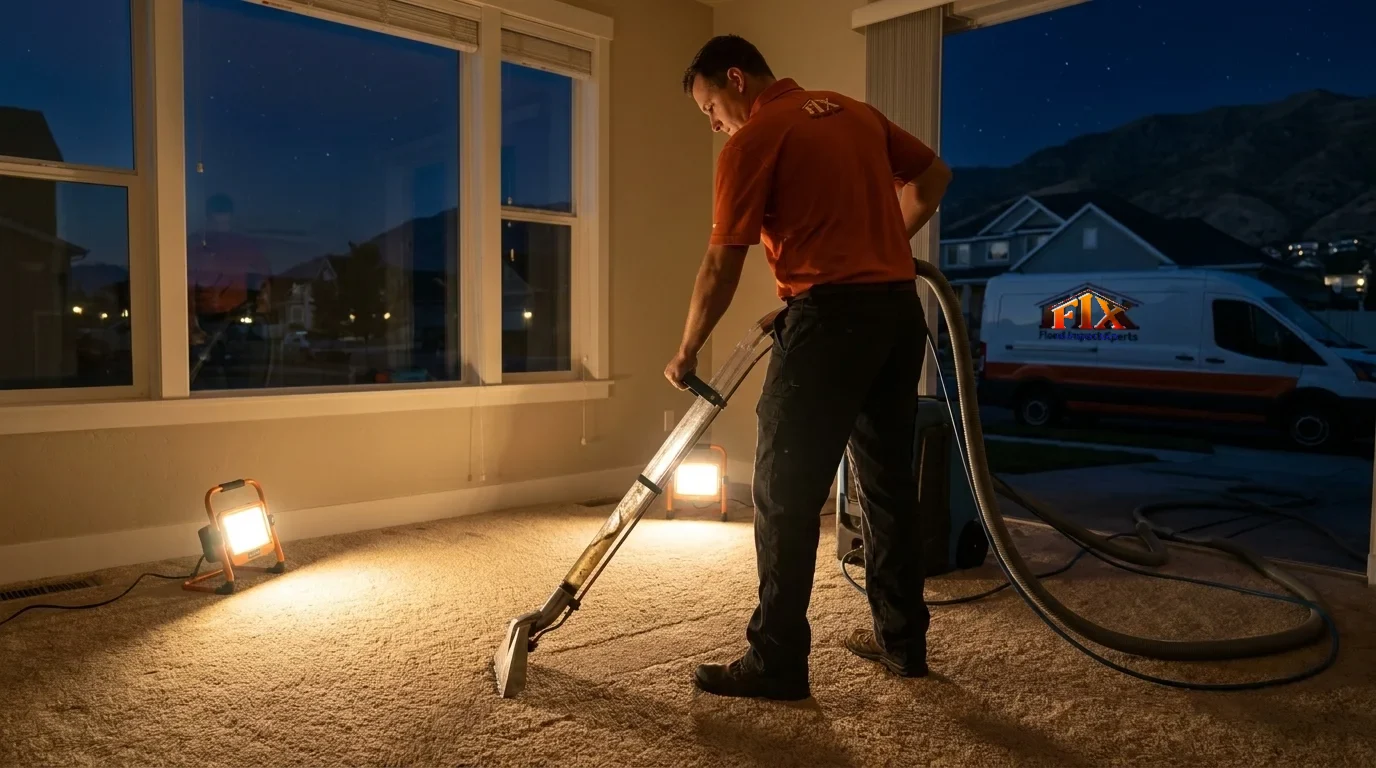
Emergency water extraction. The first priority is stopping the spread. Standing water removal begins immediately, extraction wands and weighted extraction tools pull water from carpet and hard flooring before it migrates further into subfloor assemblies or adjacent rooms.
-
Moisture mapping. Before a single piece of equipment is placed, the full extent of saturation gets documented. Thermal imaging identifies cold spots behind walls and ceilings where evaporation has cooled wet materials. Penetrating meters give exact readings at the framing level. This map drives the drying plan and becomes part of the insurance documentation.
-
Structural drying setup. Dehumidifiers and air movers are positioned according to the moisture map, not guesswork. In Category 2 or 3 losses, affected areas are isolated with poly containment barriers before drying begins to prevent cross-contamination.
-
Daily monitoring and adjustment. Drying is not set-and-forget. Moisture readings are logged at each check, typically every 24 hours, and equipment is repositioned or added as materials dry unevenly. Readings are documented for the insurance claim file.
-
Clearance and documentation. When all affected materials reach their target moisture content, final readings are recorded and a drying log is provided. If any materials (drywall, insulation, flooring) could not be dried in place and were removed, that scope is documented for the reconstruction phase.
What separates a good emergency water removal response from a bad one
The most common failure in emergency water removal is stopping too early. A surface that reads dry to the touch, or even to a pin-type meter at the surface, can still hold dangerous moisture levels at the stud, the bottom plate, or the subfloor sheathing. Crews who pull equipment before materials reach equilibrium leave behind the exact conditions that produce mold growth inside wall cavities, where it won’t be visible for weeks.
A second common problem is misclassifying the water source. Clean water losses (Category 1) can degrade to Category 2 within 24 to 48 hours as water contacts building materials, insulation, and organic debris. A response that treats a two-day-old loss as Category 1 creates both a health risk and a liability gap in the documentation.
Insurance adjusters look for a complete drying log with daily psychrometric readings (temperature, relative humidity, specific humidity, and material moisture content at each monitoring point). Without that log, a carrier may dispute whether the water removal and drying were necessary at all, or whether they were completed properly. Good documentation protects the homeowner, not just the contractor.
What does emergency water removal cost?
Typical costs for emergency water removal and cleanup vary significantly by the size of the affected area, the category of water involved, and whether materials need to be removed before drying can begin. Most homeowners pay somewhere in the following ranges for common loss scenarios, these are industry-typical figures, not quotes from FIX Restoration.
| Scenario | Typical industry range |
|---|---|
| Single room, clean water (Category 1) | $1,200 - $3,500 |
| Multi-room, clean water, hardwood or subfloor affected | $3,500 - $7,000 |
| Category 2 loss (appliance overflow, minor sewage contact) | $4,000 - $10,000 |
| Category 3 loss (sewage backup, groundwater intrusion) | $7,000 - $20,000+ |
| Crawl space water intrusion with insulation removal | $2,500 - $6,000 |
| Finished basement, full saturation | $8,000 - $25,000+ |
Every loss is different, square footage, material types, how long water sat, and what’s behind the walls all shift the number. FIX Restoration provides a written scope before work begins so there are no surprises. Homeowners insurance typically covers sudden and accidental water losses (burst pipes, appliance failures, storm-driven roof leaks) but generally excludes gradual leaks and ground-level flooding, which falls under separate flood insurance.
Seasonal and regional considerations
American Fork sits at the base of the Wasatch Front, where freeze-thaw cycles between November and March drive a predictable pattern of pipe failures. Homes built in the 1970s and 1980s, common throughout north Utah County, often have copper supply lines that have cycled through decades of expansion and contraction, and exterior hose bibs or garage-adjacent pipes that are particularly vulnerable during hard freezes. Spring snowmelt from the mountains above can also push groundwater into crawl spaces and window wells faster than drainage systems can handle, particularly on lots that slope toward the foundation.
Summer monsoon moisture occasionally pushes humidity levels high enough to accelerate mold growth in already-damp spaces, a crawl space that seemed manageable in February can become a problem by August if moisture was never fully removed.
Service area
FIX Restoration is based in American Fork and serves communities throughout north and central Utah County, including Lehi, Pleasant Grove, Lindon, Orem, Provo, Eagle Mountain, and Cedar Hills. Each city-specific page covers local considerations in more detail, but the emergency water removal and cleanup process is the same regardless of zip code: find the water, get it out completely, and document everything.
If you’re standing in a wet room right now, the clock is already running. Call FIX Restoration at (801) 930-9750 for emergency water removal, we’ll map the full extent of the loss and give you a written scope before any work begins.
Services We Handle
- Standing Water Removal
Frequently Asked Questions
Does homeowners insurance cover emergency water removal and cleanup?
How long does emergency water removal and drying take after water damage?
What's the difference between Category 1, 2, and 3 water damage, and why does it matter for water removal and cleanup?
Can water damage dry out on its own if I run fans and open windows?
What should I do while waiting for the emergency water removal crew to arrive?
Looking for the best emergency water removal & cleanup company in American Fork?
FIX Restoration provides emergency water removal & cleanup in American Fork, UT and the surrounding area, and has served local property owners since 2012. Customers rate us 4.9 out of 5 stars across 558 Google reviews. We answer calls 24/7 — call (801) 930-9750 for immediate help.
Need Emergency Water Removal & Cleanup now?
We respond 24/7 across American Fork and surrounding UT cities.
Related Coverage
- Our Restoration Services
- Contact FIX Restoration
- Emergency Water Removal & Cleanup in Highland
- Emergency Water Removal & Cleanup in Lehi
- Emergency Water Removal & Cleanup in Orem
- Emergency Water Removal & Cleanup in Pleasant Grove
- Emergency Water Removal & Cleanup in Provo
- Emergency Water Removal & Cleanup in Saratoga Springs
- Emergency Water Removal & Cleanup in Spanish Fork
- Emergency Water Removal & Cleanup in Springville
- Emergency Water Removal & Cleanup in South Jordan
- Emergency Water Removal & Cleanup in Draper
- Emergency Water Removal & Cleanup in Herriman
- Emergency Water Removal & Cleanup in Riverton
- Who to Call for Water Mitigation in American Fork, UT