
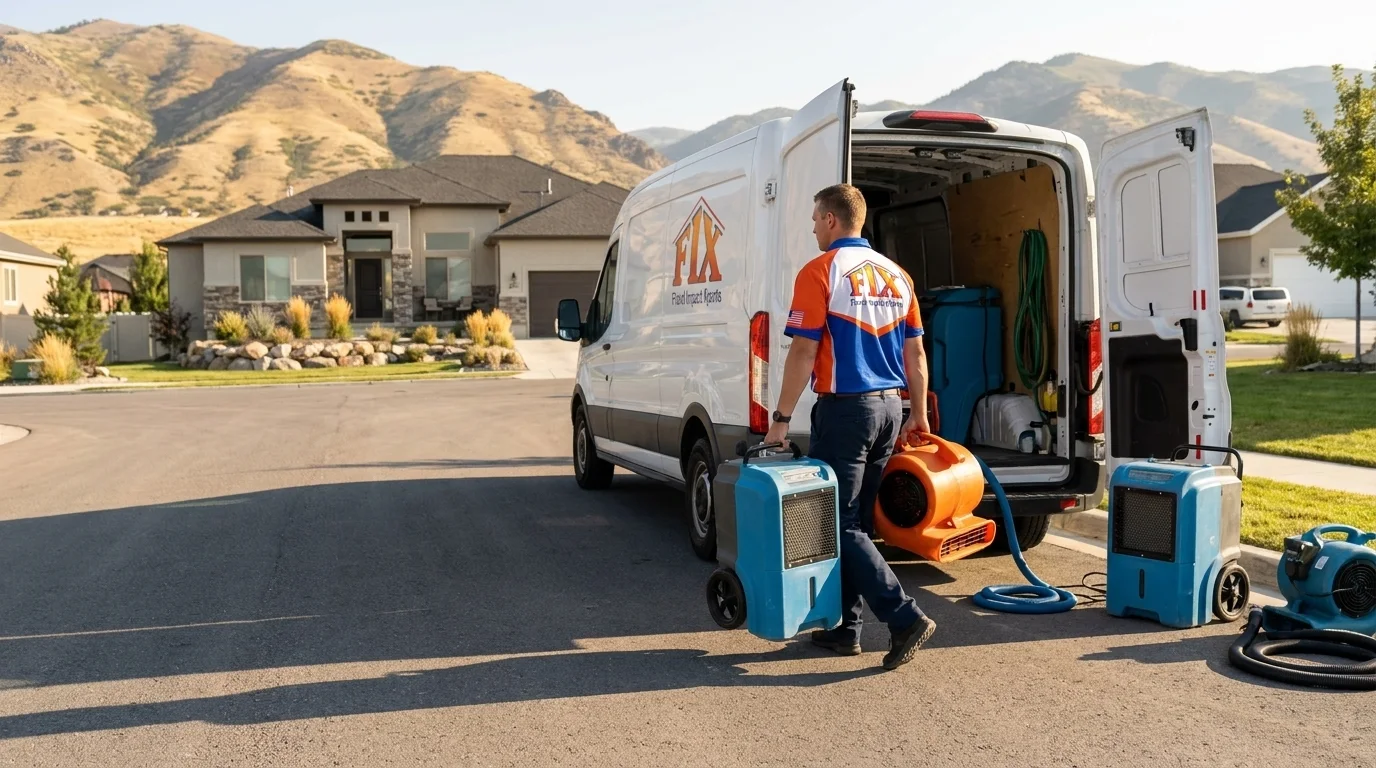
Flood & Drying Equipment Rental in American Fork
Flood & drying equipment rental in American Fork and surrounding areas. Insurance billing accepted. Call (801) 930-9750.
Standing water soaks into subfloor, wicks up drywall, and begins feeding mold colonies within 24 to 48 hours, long before the surface feels wet to the touch. If you’ve had a burst pipe, appliance overflow, or basement flood and you need the right equipment fast, renting professional-grade drying gear is often the difference between a contained cleanup and a gut-and-rebuild. FIX Restoration rents flood pumps, commercial dehumidifiers, and high-velocity air movers to homeowners and contractors in American Fork and the surrounding Wasatch Front communities.
What flood & drying equipment rental actually involves
Consumer-grade box fans and hardware-store dehumidifiers move air and pull moisture, but not at the volume or precision a water loss demands. A single room affected by a burst supply line can hold hundreds of pounds of moisture trapped in framing, insulation, and flooring assemblies. Professional drying equipment is rated in CFM (cubic feet per minute) for air movers and pints-per-day for dehumidifiers, and those ratings matter when you’re racing a 48-hour mold clock.
The equipment in a typical rental package includes:
- Submersible or trash pumps for standing water removal before drying begins
- Low-grain refrigerant (LGR) dehumidifiers that pull moisture efficiently even when ambient humidity is already dropping
- Axial and centrifugal air movers positioned to create a directed airflow across wet surfaces, pushing evaporated moisture toward the dehumidifier intake
- Moisture meters and hygrometers so you can track drying progress rather than guessing
A properly configured drying system creates a closed drying loop: air movers accelerate evaporation from wet materials, the dehumidifier captures that moisture-laden air and exhausts dry air back into the space, and readings from a moisture meter confirm when structural materials have returned to normal levels, typically between 8% and 13% moisture content for wood framing in Utah’s climate.
Our process
-
Assess the loss and select the right equipment load. Not every flood is the same. A dishwasher overflow onto a vinyl kitchen floor calls for different equipment than a sump failure that soaked a finished basement. Before you take anything off the truck, the affected area, water category, and material types determine how many air movers and what dehumidifier capacity the job actually needs.
-
Extract standing water first. Air movers accomplish nothing while water is still pooled. A submersible pump or wet-vac extraction removes bulk water so drying equipment can work on what’s left, moisture absorbed into the structure itself.
-
Position equipment using a drying pattern. Air movers are placed in a daisy-chain pattern around the perimeter of the wet area, angled low across the floor and against walls. Dehumidifiers are centrally located to capture the evaporated moisture. Improper placement, air movers pointed at each other, dehumidifiers exhausting into a corner, dramatically extends drying time.
-
Monitor daily with a moisture meter. Drying is not a set-it-and-forget-it process. Readings taken at the same reference points each day tell you whether materials are tracking toward dry or whether you have a hidden moisture pocket, inside a wall cavity, under a floating floor, or beneath a concrete slab, that the surface reading missed.
-
Confirm dry standard before equipment return. Equipment comes off rent when affected materials reach their dry standard, not when the air feels dry or the floor looks fine. Returning equipment a day early because the surface reads acceptable is one of the most common causes of secondary mold damage.
What separates a good drying response from a bad one
The most common mistake in DIY and under-equipped drying jobs is under-powering the setup. Industry guidelines suggest roughly one air mover per 50–100 square feet of wet surface area, plus dehumidifier capacity scaled to the room volume and material types. Running two air movers in a 600-square-foot basement does not create adequate airflow, it creates the appearance of drying while moisture migrates deeper into the structure.
A second frequent failure is skipping daily moisture readings. Without data, there’s no way to know whether drying is progressing, stalled, or whether a wall cavity is holding water that the surface doesn’t reveal. Insurance adjusters reviewing a claim will look for a moisture log, dated readings at consistent reference points, as documentation that drying was performed to a measurable standard, not just until the equipment got returned.
Finally, Category 2 and Category 3 water losses (gray water from appliances, sewage backups, or floodwater from outside) require containment and antimicrobial treatment before and during drying. Running air movers in a contaminated space without containment can aerosolize contaminants and spread them to unaffected areas of the home.
What does flood & drying equipment rental cost?
Typical costs for water damage drying equipment rental vary based on the size of the loss, the number of units required, and how many days equipment stays on-site. Most homeowners pay somewhere in the ranges below for the equipment portion of a drying project, these are industry-typical figures, not a quote from FIX Restoration.
| Scenario | Typical range |
|---|---|
| Single room, clean water, 2–3 day dry | $300 – $700 |
| Single room, full equipment package, 4–5 days | $600 – $1,200 |
| Multi-room loss, 5–7 day dry | $1,200 – $2,800 |
| Finished basement, full package, 7–10 days | $2,000 – $4,500 |
| Commercial space or large-scale loss | $4,500 – $10,000+ |
Every loss is different, square footage, material types, water category, and hidden moisture all affect how long equipment runs and how many units the job requires. FIX Restoration provides a written scope before work begins so you know exactly what you’re renting and why. Standard homeowners insurance typically covers sudden and accidental water losses, including the cost of drying equipment; flood damage from rising groundwater or surface flooding generally requires a separate NFIP or private flood policy.
Seasonal & regional considerations
Utah’s climate creates two distinct peaks for water damage. Spring snowmelt, particularly in years with heavy mountain snowpack above American Fork Canyon, raises the water table and puts pressure on foundation walls and sump systems throughout Utah County. Homes in lower-elevation neighborhoods near the Jordan River corridor or with older clay-tile drain systems are especially vulnerable during rapid melt events.
Winter brings a different risk: frozen supply lines in exterior walls and unheated crawl spaces. When temperatures drop sharply overnight, pipes in under-insulated rim joist areas can freeze and burst, releasing water into wall cavities that may not be discovered until a room starts to smell musty days later. Cold ambient temperatures also slow evaporation rates, meaning drying equipment may need to run longer than it would during warmer months, a factor worth accounting for when estimating rental duration.
Service area
FIX Restoration is based in American Fork and provides flood and drying equipment rental throughout Utah County and the broader Wasatch Front, including Lehi, Pleasant Grove, Lindon, Orem, Provo, Saratoga Springs, Eagle Mountain, and Cedar Hills. City-specific service pages are linked from the main service area index.
If your loss is in American Fork or a neighboring community and you need equipment today, call (801) 930-9750 to confirm availability and get the right package for your situation.
Water doesn’t wait, and neither does mold. If you’re looking at standing water or wet materials right now, call FIX Restoration at (801) 930-9750 to reserve flood pumps, commercial dehumidifiers, and air movers, and to get a clear picture of exactly what your space needs to dry correctly.
Frequently Asked Questions
Does homeowners insurance cover flood and drying equipment rental?
How many air movers and dehumidifiers do I actually need for my space?
How long will I need to keep the drying equipment running?
Can I run the rental equipment in a space that had sewage or gray water in it?
What's the difference between an axial air mover and a centrifugal air mover, and does it matter for my job?
Looking for the best flood & drying equipment rental company in American Fork?
FIX Restoration provides flood & drying equipment rental in American Fork, UT and the surrounding area, and has served local property owners since 2012. Customers rate us 4.9 out of 5 stars across 558 Google reviews. We answer calls 24/7 — call (801) 930-9750 for immediate help.
Need Flood & Drying Equipment Rental now?
We respond 24/7 across American Fork and surrounding UT cities.
Related Coverage
- Our Restoration Services
- Contact FIX Restoration
- Flood & Drying Equipment Rental in Highland
- Flood & Drying Equipment Rental in Lehi
- Flood & Drying Equipment Rental in Orem
- Flood & Drying Equipment Rental in Pleasant Grove
- Flood & Drying Equipment Rental in Provo
- Flood & Drying Equipment Rental in Saratoga Springs
- Flood & Drying Equipment Rental in Spanish Fork
- Flood & Drying Equipment Rental in Springville
- Flood & Drying Equipment Rental in South Jordan
- Flood & Drying Equipment Rental in Draper
- Flood & Drying Equipment Rental in Herriman
- Flood & Drying Equipment Rental in Riverton