
Whether your homeowners insurance covers water damage depends almost entirely on how the water got in. The short answer: sudden, accidental water damage is usually covered. Gradual leaks, flooding from outside, and damage you could have prevented are usually not. That single distinction, sudden vs. gradual, internal vs. external, drives almost every coverage decision an adjuster will make. Understanding it before you file a claim (or before you call a plumber) can save you thousands of dollars and a lot of frustration.
The Core Rule: Sudden and Accidental vs. Gradual
Most standard homeowners policies (HO-3 is the most common form in Utah) cover “sudden and accidental” water damage. Think of a washing machine supply hose that blows off at 2 a.m. a pipe that bursts during a January cold snap, or a dishwasher that leaks mid-cycle and soaks the subfloor before you notice.
What those policies almost never cover:
- A slow drip under the sink that rotted the cabinet over six months
- A roof that has been leaking for two or three seasons
- A water heater that has been seeping at the base for weeks
- Moisture intrusion through foundation cracks that has been wicking into the slab
The logic from the insurer’s perspective is straightforward: if the damage built up over time, a reasonable homeowner would have noticed and fixed it. The policy covers accidents, not deferred maintenance.
One practical note for Utah homeowners: the Wasatch Front’s freeze-thaw cycles can split supply lines and outdoor hose bibs quickly. A pipe that freezes and bursts overnight is generally covered. A pipe that froze because you left the heat off in a vacant property for weeks may not be, most policies include a clause about maintaining adequate heat.
What Is Almost Never Covered (And What to Buy Instead)
Flooding from outside your home, storm surge, overland flooding, a river that crests, or even heavy rain that backs up through a storm drain, is excluded from standard homeowners policies. For that, you need a separate flood insurance policy, typically through the National Flood Insurance Program (NFIP) or a private flood carrier.
American Fork sits in Utah County, and while the area is not high on most flood-risk maps, localized flash flooding along the Wasatch foothills can move fast and carry significant debris. If your property is near a drainage channel or sits at the base of a canyon mouth, a flood policy is worth pricing out.
Sewer and drain backup is another common gap. If a municipal sewer line surcharges during a heavy storm and pushes sewage back through your floor drain, that is not the same as a burst pipe, and most base policies exclude it. Many carriers offer a sewer backup endorsement for a modest annual premium. It is one of the most frequently overlooked add-ons in residential policies.
Mold is a downstream question. If a covered water loss is remediated promptly and mold still develops, many policies will cover mold remediation as part of the original claim. If mold developed because a leak went unaddressed for months, coverage is far less certain.
How to Document a Water Loss Before You Touch Anything
If you have an active water loss right now, documentation is the first job, before cleanup, before demo, before anything dries out.
- Stop the water source. Shut off the supply valve under the fixture, or the main shutoff if you cannot isolate it. In most American Fork homes built after the 1980s, the main shutoff is near the water meter at the front of the property or inside the garage.
- Photograph everything. Shoot wide angles of each affected room, then close-ups of the source, the standing water, and any visible damage to flooring, walls, and contents. Do this before moving furniture or pulling up rugs.
- Note the time and cause. Write down when you discovered the damage and what you believe caused it. This becomes part of your claim narrative.
- Call your insurance carrier to open a claim. You do not need to know the full scope of damage yet, just report the loss. Most carriers have 24-hour claim lines.
- Begin reasonable mitigation. Policies require you to prevent further damage once you are aware of a loss. That means extracting standing water, moving salvageable contents to a dry area, and placing towels or buckets if there is an active drip. It does not mean tearing out walls before an adjuster has seen the damage.
Do not let a contractor demo affected materials before the adjuster has documented the loss, unless the adjuster or carrier explicitly authorizes it. Premature demolition can complicate your claim.
Reading the Adjuster’s Estimate, and Knowing When to Push Back
Once your claim is open, the carrier will send an adjuster (or a third-party inspector) to assess the damage. They will typically use estimating software, Xactimate is the industry standard, to generate a line-item repair estimate.
A few things to know:
- The first estimate is not always the final number. Adjusters work from what they can see. If there is moisture behind drywall, under flooring, or inside a wall cavity that has not been opened yet, that scope is not in the initial estimate. A professional restoration company can provide moisture mapping with thermal imaging and pin meters to document hidden saturation, and that documentation can be submitted to reopen or supplement the claim.
- Depreciation and ACV vs. RCV. Most policies pay actual cash value (ACV) initially, then release recoverable depreciation once repairs are complete. Know which type of policy you have before you are surprised by a holdback.
- Your right to a public adjuster. If you believe the carrier’s estimate is significantly low, you can hire a licensed public adjuster to negotiate on your behalf. They work on a percentage of the settlement, so they are motivated to maximize the payout.
The Restoration Process: What Happens After the Claim Is Open
Insurance covers the cost of restoration, but it does not manage the restoration for you. Once your claim is approved (or even while it is pending), the drying and repair process needs to start, because water damage does not wait for paperwork.
In a typical water loss, here is what professional remediation looks like:
- Extraction: Standing water is removed with truck-mounted or portable extraction equipment. This is faster and more thorough than shop vacs or towels.
- Structural drying: Industrial air movers and dehumidifiers run continuously, often for three to five days, to bring moisture levels in framing, subfloor, and drywall back to acceptable ranges. The IICRC S500 standard governs how drying is measured and documented.
- Monitoring: Technicians return daily to take moisture readings and adjust equipment placement. Drying is not a set-it-and-forget-it process.
- Demo if needed: Saturated drywall, insulation, and flooring that cannot be dried in place are removed. This is called “controlled demolition” and is documented for the insurance file.
- Reconstruction: Once the structure is dry and cleared, repairs begin, new drywall, flooring, paint, cabinetry, whatever the scope requires.
The restoration company works from the same Xactimate platform the adjuster used, which makes line-item billing to the carrier more straightforward.
When to Call a Professional
If the affected area is larger than about 10 square feet, if water has been sitting for more than a few hours, or if you suspect it has reached subfloor or wall cavities, this is not a DIY dry-out situation. Hidden moisture that is not fully dried within 24 to 48 hours creates conditions where mold can begin to colonize, and mold remediation is a separate, more involved process than water damage restoration.
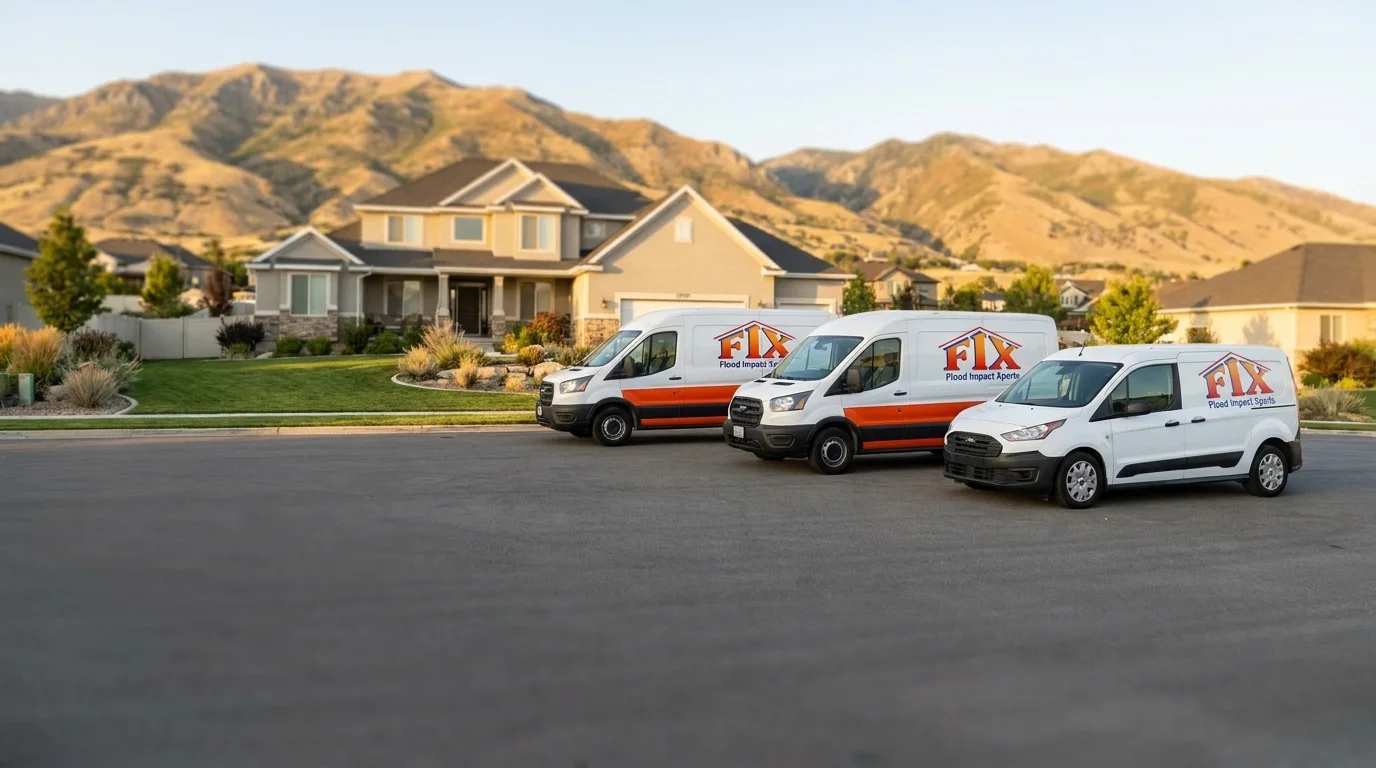
If you are dealing with a water loss in American Fork or anywhere in Utah County and you are not sure what your next step should be, FIX Restoration can be reached at (801) 930-9750. Even if you are still in the middle of the insurance process, a professional assessment of the moisture scope costs you nothing in terms of your claim, and it gives you documentation that protects your interests.